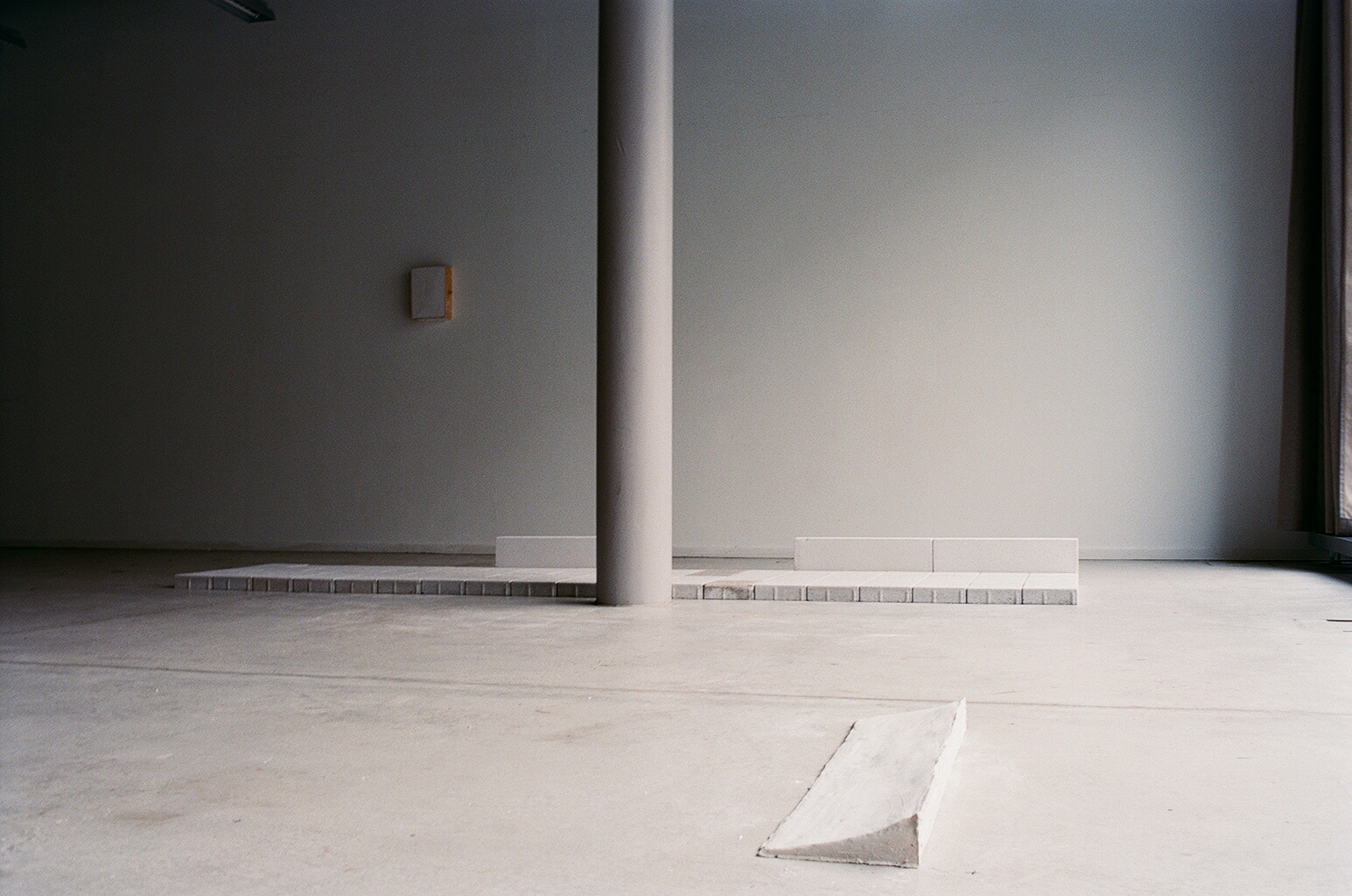
Oscillation
Works by Tim White-Sobieski
Opening during Zurich Art Weekend: June 13, 2026, from 12am-6pm
Exhibition: June 12 to June 30, 2026
This exhibition presents a new body of work by Tim White-Sobieski (*1961), bringing together recent paintings and a large-scale light installation that together articulate a sustained inquiry into image, temporality, and perception.
Long recognized for his engagement with lens-based and time-based media, White-Sobieski approaches painting here as an expanded field, one in which the conditions of visibility are constructed, destabilized, and reconfigured. TThe paintings of Tim White-Sobieski consistently operate at the threshold where figuration dissolves into a field of perceptual intensities. Across his practice, composition is conceived not as a fixed arrangement but as a stratified chromatic architecture, often anchored in saturated registers, yet never bound by them, in which form remains suspended between emergence and disappearance. Rather than stabilizing pictorial space, these works generate conditions of visual indeterminacy, where elements appear contingently, as if held in a state of continuous negotiation.
Within this unstable field, quasi-figurative configurations frequently arise: hybridized bodies that seem assembled from fragments, part skeletal, part prosthetic, part mnemonic trace. These figures resist anatomical coherence; they are constructed through juxtaposition rather than continuity, evoking presences that are simultaneously articulated and undone. They do not assert themselves as subjects in the traditional sense, but persist as provisional structures, as though they were residues of images still forming or already dissolving. Their gestures often oscillate between inwardness and exposure, suggesting a persistent tension between containment and dispersal.
The surrounding pictorial environment reinforces this ambiguity. Vertical chromatic bands, organic silhouettes, and shifting planes establish spatial rhythms that hover between landscape and abstraction, between architecture and growth. Such elements refuse singular interpretation: they may read as arboreal, structural, or purely painterly intervals. This semantic instability is not incidental but constitutive. Fine linear tracings, reminiscent of branches, vascular systems, or neural networks, traverse the surface, binding disparate zones into a tenuous continuity. These lines function less as descriptive devices than as connective tissues, articulating each painting as a dynamic system rather than a static image.
Materially, White-Sobieski’s paintings are governed by a sustained logic of layering, revision, and temporal accumulation. Opaque passages coexist with translucent veils; gestures are inscribed, obscured, and reactivated. The surface records not only the act of painting but the duration of its unfolding, its hesitations, reversals, and reconfigurations. This stratification resists closure: each layer remains partially visible, contributing to a depth that is as temporal as it is spatial. The works do not present themselves instantaneously; they disclose their structure incrementally, requiring a durational mode of attention.
Central to this practice is a calibrated tension between revelation and concealment. Visual information is neither fully given nor entirely withheld, but modulated across the surface. The viewer is thus implicated in the construction of the image: perception becomes an active, generative process, continually destabilized as forms shift, dissolve, and reconstitute. Seeing is not a passive reception but an event, one that unfolds in time and remains fundamentally unresolved.
Situated within the expanded discourse of contemporary painting, White-Sobieski’s work extends the medium beyond representation toward an inquiry into the very conditions of visibility. His paintings function as perceptual apparatuses: they stage the emergence of form as a temporal phenomenon, foregrounding the instability of what is seen and the contingency of how it is known. Rather than offering resolved images, they construct open fields, sites in which perception becomes recursive, durational, and perpetually in flux.
The light installation extends these concerns into the spatial domain. Through the orchestration of material, light, and architectural intervention, it situates the viewer within a perceptual continuum that exceeds the pictorial frame. The distinction between object and environment is thereby attenuated, and the act of viewing is reconstituted as a spatial and temporal experience.
Rather than offering resolution, the works maintain a state of openness. They foreground processes of becoming over fixed form, and in doing so, align with a broader discourse in which painting operates as a mode of inquiry rather than representation.
This exhibition situates White-Sobieski’s current practice within this expanded field, underscoring a consistent engagement with the instability of the image and the conditions under which it is perceived. It proposes a reconsideration of painting as a site of temporal and perceptual negotiation, one that unfolds not instantaneously, but through sustained encounter.
Tim White-Sobieski has had major solo shows in Vejle Kunstmuseum, Vejle, Denmark;[37] CAC Centro de Arte Contemporáneo Malága, Spain; Museo Centro de Arte de Salamanca, Domus Artium Spain. Additionally, he has been exhibited at Academy of Arts, Berlin, (Akademie der Künste), Germany; Palais de Tokyo, Paris, France; Haus der Kulturen der Welt, Berlin, Germany; Museo Nacional Centro de Arte Reina Sofía, Madrid, Spain; Stenersen Museum, Oslo, Norway; Prague National Gallery, Prague, Czech Republic; and the National Museum of Contemporary Art (Romania) (MNAC), Bucharest.
Furthermore work belongs to the collections of Aena Foundation (FUNDACIÓN AENA), Madrid, Spain;[12] CITI Bank Collection, New York, New York; Collection of Academy of Arts, Berlin (Akademie der Künste), Germany; La Fundación Luis Seoane, A Coruña, Spain; Collezione Foundation LA GAIA, Busca, Italy; Denver Art Museum (DAM), Denver, CO; Fundación Rac (Rosón Arte Contemporáneo, Pontevedra, Spain; ING Art Collection,[39] (Brussels, Amsterdam, London, New York); L’Oreal Collection, Paris, France; Louis Vuitton Foundation, Paris, France; Museo de Bellas Artes de Santander, SANTANDER, Spain; Museo Nacional Centro de Arte Reina Sofía (MNCARS), Madrid, Spain; Centro Galego de Arte Contemporanea, Museum of Contemporary Art CGAC, Santiago de Compostela, Spain; Museum of Contemporary Art Elgiz, Istanbul, Turkey; Museum of Contemporary Art GAM, Torino, Italy; Museum of Contemporary Photography (MoCP), Chicago, IL, USA; New York Public Library Print Collection, New York, New York; The Miriam and Ira D. Wallach Division of Art, Prints and Photographs, New York, New York; and the UBS collection of Contemporary Art, Basel, Switzerland.