Paul Cézanne
Born 1839 in Aix-en-Provence; died 1906 in Aix-en-Provence
Paul Cézanne transformed the course of modern painting by making perception itself a sustained artistic problem. Working in the decades when European art was moving away from academic convention and toward new forms of visual experience, Cézanne developed a language that was at once deeply rooted in observation and radically independent of appearances. For him, nature was not a stable image waiting to be reproduced. It was something continually reconstructed through looking: shifting, provisional, and resistant to complete resolution.
Although he emerged from the generation of the Impressionists and exhibited with them, Cézanne pursued a markedly different ambition. Where Impressionism often emphasized transient light, atmosphere, and the immediacy of sensation, Cézanne sought to give those sensations structure and duration. He wanted painting to possess the weight and coherence of the old masters while remaining faithful to the instability of modern vision. This tension, between permanence and flux, order and perception, became one of the defining forces of his work.
Across still lifes, portraits, landscapes, and scenes of bathers, Cézanne repeatedly tested the relationship between color, volume, and space. Objects are rarely contained by fixed contours. Instead, forms emerge through modulations of color, overlapping planes, repeated brushstrokes, and subtle shifts in viewpoint. A table may seem to tilt toward the viewer; a bowl appears simultaneously seen from above and from the side; the edge of a figure dissolves into the surrounding landscape. These apparent inconsistencies are not errors of perspective but deliberate signs of a more complex act of seeing. Cézanne does not present the world from a single, stable position. He records the experience of looking over time.
His still lifes reveal this process with particular intensity. Apples, bottles, cloths, plates, and tabletops become more than everyday objects. Their relationships generate a fragile architecture in which balance is continually negotiated. Cézanne’s apples are among the most ordinary subjects in the history of painting, yet under his attention they acquire an almost monumental presence. Their weight and volume are established not through conventional modeling but through color itself. Warm and cool tones advance and recede, building form directly on the painted surface.
Landscape offered Cézanne an equally demanding field of inquiry. In Provence, where he spent much of his life, he repeatedly painted the same hills, quarries, forests, houses, and above all Mont Sainte-Victoire. The mountain became less a motif than a structure through which he could investigate how distance, atmosphere, geology, and vision interact. In the later paintings, sky, trees, rock, and mountain seem to interlock within a continuous fabric of brushstrokes. Depth remains present, but the picture also insists on its own material surface. The viewer moves between recognizing a landscape and recognizing a painting.
This tension between illusion and construction became fundamental to twentieth-century art. Cézanne demonstrated that a painting could refer to the visible world while simultaneously revealing the means by which that world is organized on a flat surface. His work profoundly affected Pablo Picasso and Georges Braque, who found in Cézanne’s fractured spatial relationships a foundation for Cubism. Henri Matisse admired the discipline and structural intelligence of his painting. Generations of artists would return to Cézanne’s work as a model for how representation might be dismantled, reorganized, and renewed.
Yet Cézanne’s importance cannot be reduced to his influence on later movements. His paintings retain their force because they remain unresolved. They do not offer a final answer to the problem of representation. Instead, they preserve the tension between what the eye sees, what memory retains, and what painting can construct. The visible world is never simply transferred onto canvas; it is repeatedly questioned and rebuilt.
Cézanne’s art therefore occupies a pivotal position between the nineteenth and twentieth centuries. He looked intensely at nature while simultaneously loosening painting from the obligation to imitate it. In doing so, he established a new conception of the image: not as a transparent window onto reality, but as an independent field in which sensation, structure, time, and thought converge.
His work remains radical because it refuses certainty. Mountains, bodies, apples, and rooms seem always in the process of becoming visible. Each painting records an encounter between the world and the act of seeing it. In Cézanne, modern painting begins not with the abandonment of reality, but with the recognition that reality can never be seen from only one point of view.
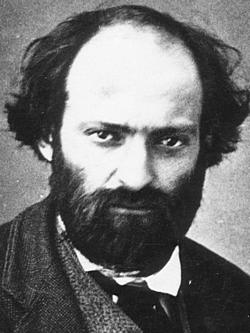
Paul Cézanne @the artist; photographer: n/a