Julian Tauland
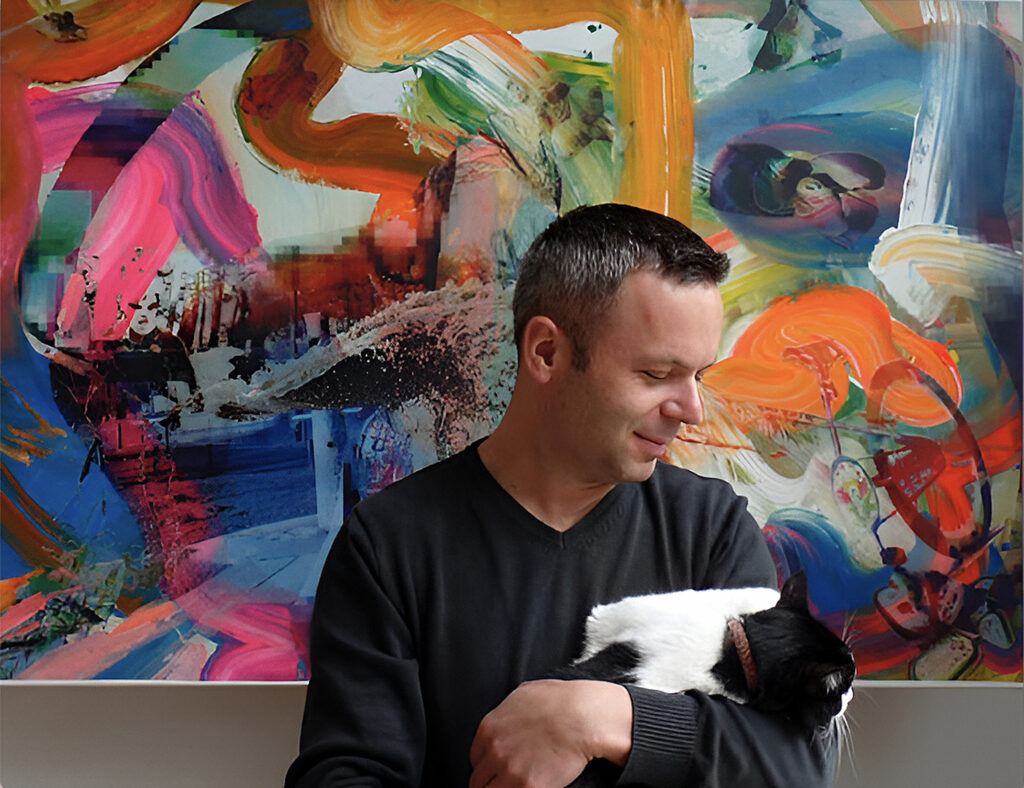
Julian Tauland’s Entrelacs / Eden series represents a compelling investigation into the permeable boundaries between abstraction and figuration, a dialectic that has haunted and propelled painting since its modern inception. His large-scale canvases, realized through a nuanced application of mixed media on linen, beckon the viewer into a space where the familiar is destabilized, giving way to a dynamic interplay of color, gesture, and form, a becoming rather than a being.
Tauland’s compositions are not merely arbitrary arrangements; they are meticulously orchestrated paintings. A central element, the variety of colors, from deep emerald greens to rich cobalt blues, and delicate ochre and beige tones, red and orange, simultaneously defines and deconstructs the very notion of landscape. Layers of lush greens and blue nuances evoke a sense of depth and allude to the presence of vegetation, while strategically deployed lighter bands introduce a deliberate spatial ambiguity, confounding conventional perspectives. This mirrors the inherent indeterminacy of perception itself.
The artist’s masterful deployment of gestural brushstrokes engenders a sensation of perpetual movement and transformation. Forms emerge and recede, fleetingly hinting at figuration, a spectral suggestion of a figure or a tree, only to dissolve once more into the abstract field. This inherent fluidity encapsulates Tauland’s preoccupation with capturing the evanescent nature of perception and the ever-shifting contours of his and our world.
The Entrelacs series reveals a heightened awareness of the viewer’s participatory role. The works directly engage with the act of looking, prompting contemplation and demanding a profound engagement with the artist’s personal memories, experiences, and observations. While grounded in personal narratives, Tauland’s paintings transcend the merely autobiographical, unfolding into a broader meditation on the present moment, where the interiority of memory converges with the ceaselessly evolving landscape of reality. They are not mere objects to be passively consumed, but rather catalysts for active engagement in the perpetually unfolding process of world-making.
Tauland’s artistic oeuvre is not simply an aesthetic voyage; it is a provocative invitation to actively participate in the construction of landscape, both literal and metaphorical. Through his evocative manipulation of color, texture, and form, he challenges viewers to reimagine the world according to their own subjective understanding, fostering a reciprocal dialogue between the artist’s carefully considered vision and the observer’s individual interpretation. This is achieved through an elaborate interplay of brushstrokes and colors, resulting in a complex network where each element exerts a profound influence on all others.
In a broader art historical context, Tauland’s oeuvre resonates with a constellation of key movements and figures. Echoes of Abstract Expressionism are discernible in his gestural approach and emphasis on the performative act of painting itself, a kinship with the groundbreaking work of Willem de Kooning. However, Tauland deliberately transcends the limitations of pure abstraction, subtly integrating elements of figuration. He can also be conceptually linked to the landscape painters of Impressionism and Post-Impressionism, such as Claude Monet and Paul Cézanne, in his radical deconstruction of traditional landscape representation, focusing instead on the ephemeral qualities of color, light, and atmosphere.
Yet, Tauland transcends mere empirical observation, transforming the landscape into a deeply personal, interiorized space. The commingling of reality and imagination, and the exploration of unconscious processes, recall the visionary work of Surrealist artists such as Max Ernst, although Tauland eschews overt symbolism, generating a subtle sense of disruption through the seamless blending of abstraction and figuration. Finally, Tauland’s liberated, non-representational painting aligns with the traditions of Art Informel, which emerged in the 1950s as a defiant counterpoint to geometric abstraction, with artists like Hans Hartung defending the primacy of spontaneous action and the subjective experience of the artist.
Tauland’s unique artistic vision and singular contribution to painting lie in his remarkable ability to synthesize disparate influences into a compelling visual language that encourages viewers to actively engage in contemplation. In an era increasingly dominated by a technocratic art language and aesthetic, a legacy of the past two decades in the Western hemisphere, Tauland’s work stands as a vital counterpoint. It reaffirms the power of subjective experience, the enduring relevance of human gesture, and the redemptive potential of painting as a means of forging a deeper, more meaningful connection with the world around us by integrating art history. His work envisions a future where art is not merely a reflection of technological progress but a potent force for reclaiming the beauty of nature.