Keith Haring
Born 1958 in Reading, Pennsylvania; died 1990 in New York City.
Keith Haring emerged in New York at the beginning of the 1980s with a visual language that was at once radically direct and immediately recognizable. Moving between the street, the subway, the nightclub, and the gallery, he developed an art grounded in the energy of public space and in the conviction that images could communicate across social, cultural, and economic boundaries.
Haring’s vocabulary, radiant babies, barking dogs, dancing figures, hearts, crosses, televisions, and bodies in continuous motion, was built from an economy of line. Bold, rhythmic, and deliberately accessible, these forms transformed complex subjects into images of extraordinary clarity. Beneath their apparent simplicity, however, lies a persistent engagement with power, violence, sexuality, religion, technology, consumer culture, and the vulnerability of the human body.
His early subway drawings, executed in chalk on the unused black advertising panels of New York City stations, were central to this development. Created in direct contact with an anonymous and constantly changing public, they challenged conventional distinctions between museum and street, high art and popular culture, private expression and collective experience. For Haring, accessibility was not a compromise but a fundamental artistic position.
As his international reputation expanded, so did the political dimension of his work. Haring used his imagery to address racism, nuclear anxiety, apartheid, drug addiction, and the AIDS crisis, while remaining deeply committed to education, community projects, and public art. The speed and immediacy of his line became inseparable from the urgency of the subjects he confronted.
Keith Haring’s work occupies a singular position in late twentieth-century art. Combining the visual force of graffiti, comics, advertising, abstraction, and ancient symbolic systems, he created an iconography that belongs simultaneously to the history of art and to the shared visual culture of everyday life. More than three decades after his death, his images retain their extraordinary vitality: open, democratic, and insistently alive.
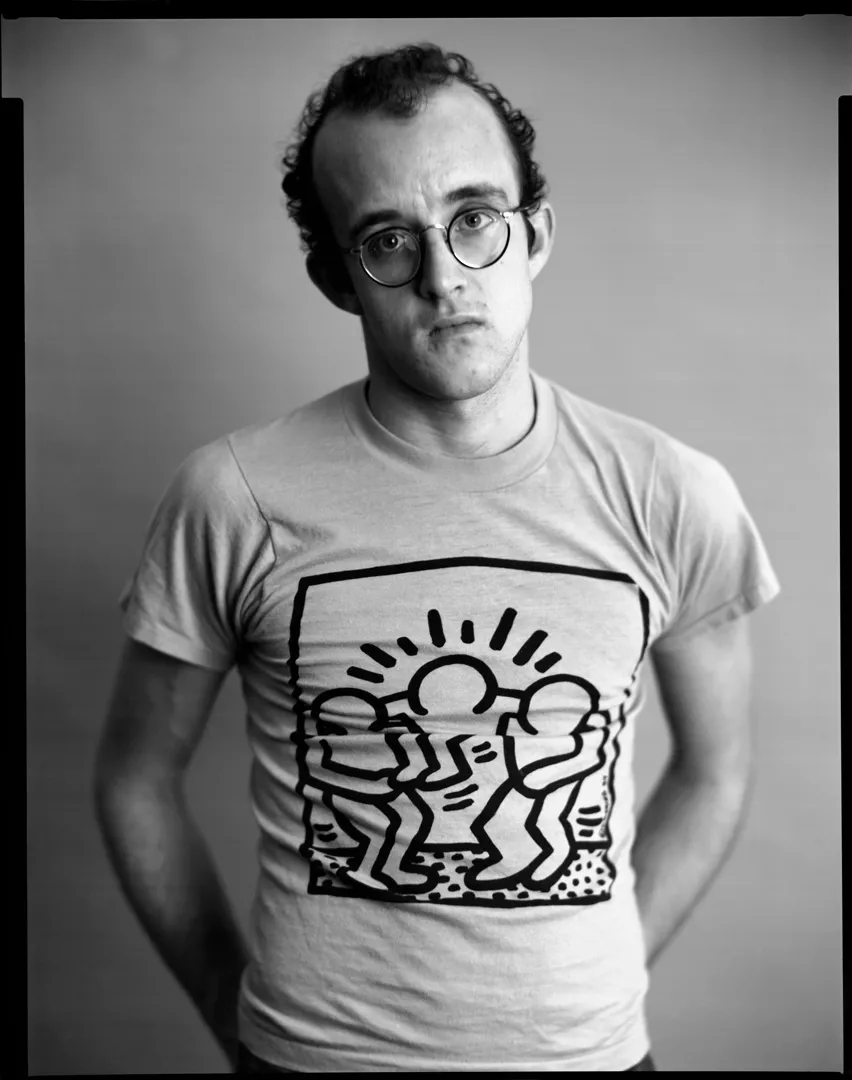
© Keith Haring Foundation, Photographer: Timothy Greenfield-Sanders, 1985