Lawrence Weiner
Born 1942 in New York; died 2021 in New York
Lawrence Weiner (1942–2021) radically redefined what a work of art could be by locating its primary form not in an object, but in language. Emerging in the 1960s as a central figure in Conceptual art, Weiner abandoned the expectation that an artwork had to be physically fabricated in order to exist. Instead, he developed a practice built around concise verbal propositions, statements describing materials, actions, conditions, and possible transformations. Installed directly on walls, printed in books, reproduced on posters, or spoken aloud, these works insist that language itself can function as sculpture: occupying space, activating thought, and generating images in the mind.
Weiner’s decisive breakthrough came from questioning the necessity of artistic production itself. In 1968, he formulated a now foundational principle of his practice: an artwork could be constructed, it could be fabricated by someone else, or it did not need to be built at all. What mattered was the proposition and the possibility it contained. This shift challenged conventional ideas of authorship, permanence, ownership, and material value. The artwork no longer depended on a unique object produced by the artist’s hand; it could exist as an instruction, an idea, or a linguistic structure capable of being realized in different places and at different times.
His statements often appear deceptively simple. Phrases such as descriptions of objects being removed, materials displaced, things placed beside or upon one another, or substances altered by contact resemble fragments of practical instruction. Yet Weiner’s language is deliberately open. It does not tell the viewer what to imagine, nor does it insist that the described action actually occur. Instead, each work establishes a conceptual field between language and material, possibility and actuality. A few words can suggest weight, movement, pressure, distance, erosion, construction, or disappearance. The reader becomes an active participant, completing the work mentally and situating it within their own experience.
This economy of language was never synonymous with neutrality. Weiner was acutely attentive to typography, scale, placement, architecture, and the social environments in which his words appeared. His texts might stretch across the façade of a museum, hover above a doorway, interrupt a gallery wall, or appear unexpectedly in a public space. The surrounding architecture became part of the work, as did the movement of viewers through it. Language was not simply read; it was encountered physically. Words could function as both information and image, simultaneously occupying conceptual and spatial territory.
For Weiner, sculpture was fundamentally concerned with relationships between materials and the world. His linguistic works therefore retained a strong material vocabulary: stone, wood, water, earth, metal, paint, pressure, motion, and gravity recur throughout his practice. Yet these materials are often present only as words. By describing physical actions without necessarily carrying them out, Weiner transferred the materiality of sculpture into the imagination. The resulting tension, between what exists before us and what language enables us to conceive, is central to his work.
This approach also carried important political and social implications. By detaching art from the requirement of a precious or singular object, Weiner challenged the exclusivity of traditional art production and circulation. Language could travel. A work could be translated, printed inexpensively, installed in radically different contexts, or understood without direct access to an original artifact. His practice proposed a form of art that was at once rigorous and unusually democratic: one whose realization depended not on possession, but on comprehension and encounter.
Translation became an essential part of this expanded field. Weiner’s works have appeared in numerous languages and cultural contexts, and he accepted the instability that translation necessarily introduces. Meaning could shift slightly from one language to another, just as the physical significance of a work changed when installed in a new architectural or social environment. Rather than diminishing the work, these transformations underscored its adaptability. Language, for Weiner, was not a transparent vehicle for a fixed idea; it was itself a material capable of alteration.
His visual identity became equally distinctive. Capital letters, emphatic punctuation, graphic symbols, and sharply composed typographic arrangements gave many of his installations an immediate physical presence. Although Weiner resisted treating typography as decorative design, the visual form of his language became inseparable from its impact. Words could assert themselves architecturally, turning the wall into a field of tension between reading and seeing.
Across more than five decades, Weiner remained remarkably consistent in his fundamental proposition while continually expanding its implications. He worked through books, films, posters, multiples, public commissions, records, and large-scale architectural installations, resisting distinctions between supposedly major and minor forms. A museum wall, a matchbook, a ship, or a city façade could all become equally valid sites for art.
Weiner’s importance lies not only in his role in the history of Conceptual art, but in the lasting transformation he brought to the relationship between language, object, and viewer. He demonstrated that an artwork could exist as a set of conditions rather than as a fixed thing, and that meaning could be produced through the encounter between words, spaces, and individual imagination. In his work, language does not describe sculpture from a distance. Language becomes sculpture itself, material without mass, architecture without permanence, and an object reconstructed anew each time it is read.
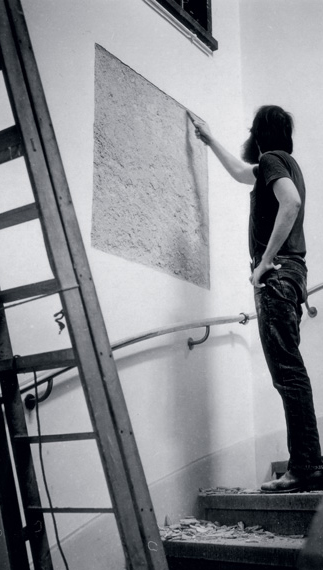
Lawrence Weiner, A 36” X 36” REMOVAL TO THE LATHING OR SUPPORT WALL OF PLASTER OR WALLBOARD FROM A WALL, 1968
Weiner constructing the work for “When Attitudes Become Form: Works-Concepts-Processes-Situations-Information at the Kunsthalle Bern”, 1969,
© Alice Zimmerman Weiner & Whitney Museum of American Art; photo by Shunk Kender, Courtesy Harald Szeemann Archive, Switzerland
Watch: Lawrence Weiner – when attitudes become form (exhibition), Bern, Switzerland