Matt Mullican
Born 1951 in Santa Monica, California, USA
Matt Mullican (born 1951) has spent more than five decades constructing one of the most expansive and idiosyncratic systems in contemporary art. Moving across drawing, painting, sculpture, performance, installation, photography, video, architecture, and hypnosis, his work asks a fundamental question: how do we organize reality, and how do the signs, symbols, and structures we create come to shape what we believe to be real? Rather than treating the world as a stable set of facts, Mullican approaches it as a field of classification, an immense network in which perception, language, memory, knowledge, and imagination continually overlap.
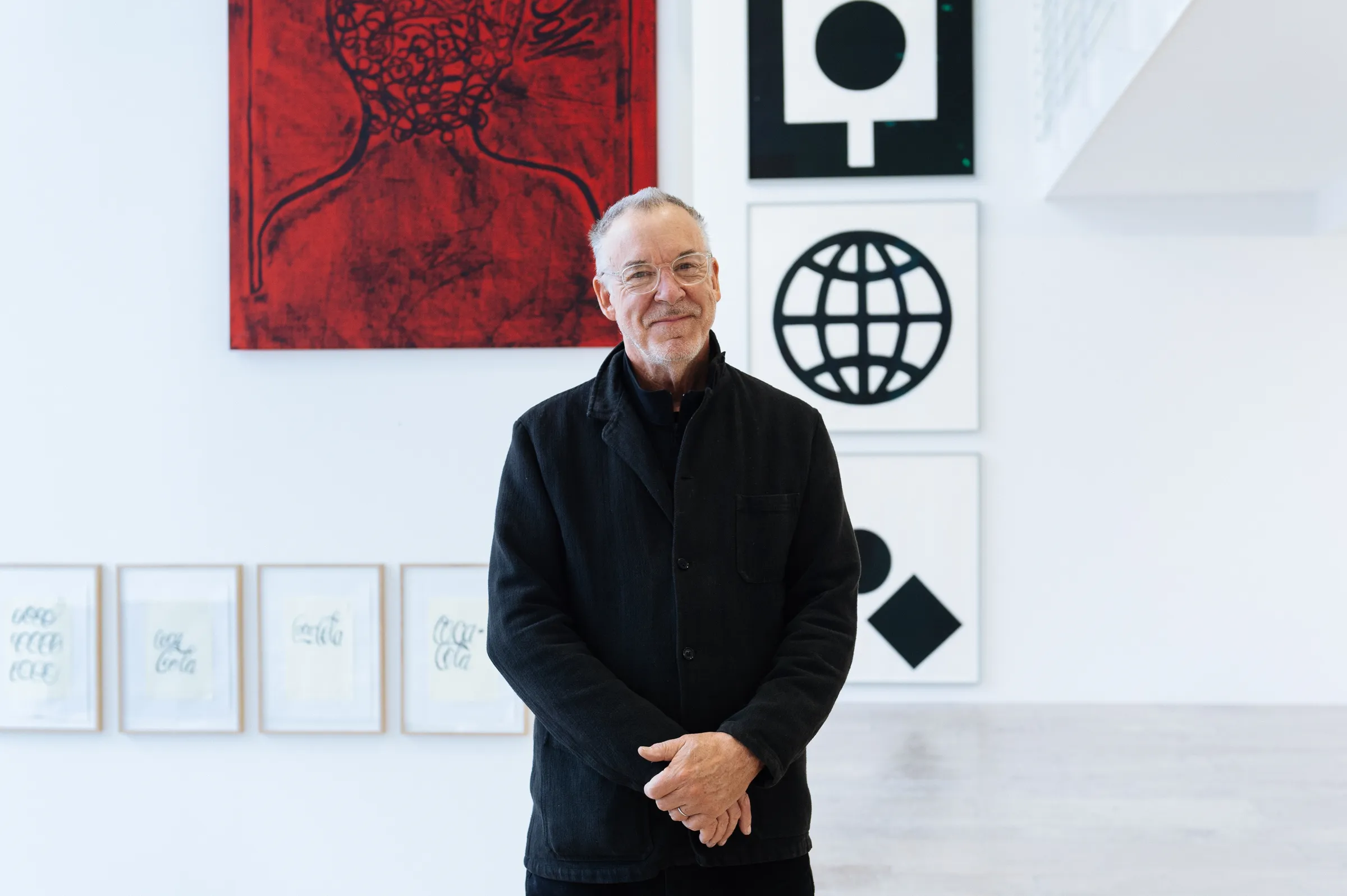
At the center of his practice is a visual and conceptual cosmology that he began developing in the 1970s. Mullican divided experience into recurring categories, each associated with a distinct color and symbolic function: the material world, the world of everyday life, the realm of culture and language, the domain of the arts, and the subjective or spiritual sphere. These systems appear in diagrams, charts, pictograms, banners, rubbings, flags, architectural models, and large-scale installations. Their apparent order suggests the logic of maps, encyclopedias, urban planning, or information design, yet the systems never fully stabilize. Instead, they reveal how arbitrary, fragile, and deeply human our attempts to classify existence can be.
Mullican emerged at a moment when artists were increasingly questioning the status of images and the mechanisms through which meaning is produced. While Conceptual art had shifted attention away from the autonomous object toward ideas, language, and systems, Mullican pushed this inquiry into a more psychological and existential territory. He became interested not only in what signs mean, but in how consciousness itself constructs meaning. A pictogram of a house, a person, a city, or an abstract concept does not merely stand for something; it enters into a larger mental architecture through which the world becomes intelligible.
This interest in symbolic systems led Mullican to develop what he has described as a “world”, a vast, evolving model of reality that exists across different scales and media. Sometimes it appears as a diagram on paper; elsewhere it takes the form of a fictional city, an immersive installation, or a digitally rendered environment. These works collapse distinctions between the personal and the universal. They suggest both a private cosmology and a model for collective experience, as though the artist were attempting to chart not a physical territory but the very process by which human beings structure knowledge.
One of the most radical aspects of Mullican’s practice is his long-running work under hypnosis. Since the late 1970s, he has used hypnosis to access an altered state in which he performs, draws, writes, and speaks as what he calls “That Person”, a figure understood not simply as a fictional alter ego, but as another condition of consciousness. These performances complicate conventional ideas of authorship and intentionality. If an artwork is produced while the artist is in an altered mental state, who is responsible for its gestures, decisions, or meanings? Mullican does not use hypnosis to uncover some hidden “authentic self.” Rather, he treats identity itself as unstable, layered, and constructed.
The drawings and writings produced through these performances often possess an urgent, repetitive intensity. Words, numbers, symbols, rudimentary figures, and fragmented statements accumulate across surfaces, oscillating between private notation and public language. They appear at once deeply personal and strangely impersonal, as though emerging from a system that exceeds the conscious individual. Here, Mullican’s lifelong interest in signs becomes inseparable from questions of psychology: the same symbolic structures that organize the external world also shape the interior one.
His use of pictograms further reflects this tension between universality and subjectivity. Reduced to simplified graphic forms, Mullican’s symbols resemble the visual language of airports, road signs, maps, and computer interfaces—systems designed to communicate across linguistic and cultural boundaries. Yet within his work, these seemingly neutral signs become ambiguous. Their meanings depend on context, repetition, placement, and the viewer’s own associations. The very tools designed to make the world legible expose the instability of interpretation.
Throughout his career, Mullican has repeatedly enlarged these systems into architectural and spatial environments. Flags, banners, floor plans, light boxes, monumental rubbings, and constructed rooms transform galleries into immersive fields of information. The viewer does not merely look at the work but moves through it, navigating a visual grammar whose rules are partially visible yet never entirely explained. This experience recalls the act of moving through a city or an archive: surrounded by signs, structures, and categories, one is continually interpreting, orienting, and assigning meaning.
Mullican’s work is also deeply concerned with the gap between representation and experience. A photograph of a person is not the person; a word is not the thing it names; a map is not the territory it describes. Yet these representations become powerful precisely because we continually treat them as substitutes for reality. Mullican’s practice occupies this gap. His art makes visible the systems through which abstraction becomes belief and through which signs acquire emotional, social, and psychological force.
Across more than half a century, Mullican has constructed an extraordinary body of work that is at once systematic and deeply subjective, encyclopedic and elusive. His practice moves between the rational impulse to categorize and the impossibility of fully containing experience within any system. By treating reality as something continuously produced through language, images, memory, and perception, he has created not simply a vocabulary of signs but a model of consciousness itself.
Mullican’s importance lies in this persistent expansion of what an artwork can contain. His work is not only about images, objects, or symbols, but about the mental structures that allow them to become meaningful. In his universe, the world is never simply given; it is constantly interpreted, divided, named, remembered, and imagined. What appears at first as a system of classification ultimately becomes something far more profound: an investigation into how human beings construct reality, and how fragile, provisional, and astonishing that construction can be.