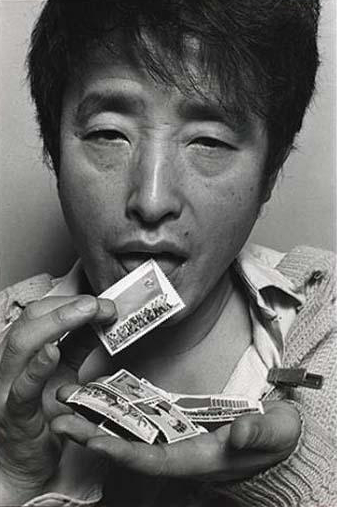
Nam June Paik
Nam June Paik transformed the technologies of mass communication into a radical new language for art. Working across video, television, performance, music, sculpture, and installation, he approached electronic media not simply as tools for transmitting information, but as materials capable of reshaping perception, culture, and human experience.
Born in Seoul in 1932 and educated in Japan and Germany before eventually settling in New York, Paik emerged from the experimental environments of avant-garde music and Fluxus during the 1960s. His early encounters with composers and artists including John Cage profoundly influenced his understanding of chance, participation, and the dissolution of traditional boundaries between artistic disciplines. Rather than treating technology as separate from the body or everyday life, Paik understood it as an increasingly intimate extension of both.
Television became central to this investigation. At a moment when the medium was rapidly entering domestic life, Paik disrupted its conventional function. He altered television signals, manipulated images, incorporated monitors into sculptural forms, and invited viewers to interact with electronic systems. The television set, normally a passive receiver of broadcast information, became an active artistic object: unstable, playful, physical, and open to transformation.
Throughout his practice, Paik brought together apparent opposites: East and West, technology and spirituality, mass media and individual experience, the mechanical and the organic. Works incorporating Buddha figures confronting television monitors created a recursive encounter between contemplation and electronic representation, while his celebrated robot sculptures transformed technological components into humorous, distinctly human presences.
Paik was equally interested in communication across distance. Long before digital networks became embedded in everyday life, he imagined a world connected through electronic images and instantaneous transmission. Satellite broadcasts and ambitious global projects allowed him to consider television not merely as a medium of mass culture but as a space through which geographical, political, and cultural boundaries might be crossed.
Yet Paik’s relationship with technology was never simply celebratory. His work continually reveals the tensions embedded within technological progress: between connection and isolation, information and overload, control and participation. Humor and experimentation allowed him to approach these questions without reducing them to fixed conclusions.
Central to Paik’s significance is his recognition that the moving image would fundamentally alter the conditions under which art is produced, circulated, and experienced. By transforming televisions, cameras, video signals, and communication networks into artistic materials, he expanded the possibilities of sculpture and installation while helping establish video as a major medium of contemporary art.
Across a practice spanning several decades, Paik remained less interested in technology itself than in what technology might do to human experience. His work asks how images move, how information circulates, how distance is collapsed, and how individuals locate themselves within increasingly mediated environments.
In Paik’s hands, the television ceased to be merely a screen onto the world. It became an object, an instrument, a sculpture, and ultimately a way of imagining how art might inhabit an electronic future.