Paul Klee
Born 1879 in Münchenbuchsee, Bern, Switzerland; died 1940 in Muralto, Ticino, Switzerland
Paul Klee occupies a singular position in the history of modern art. Neither fully aligned with Expressionism, Cubism, Surrealism, nor abstraction, he developed a visual language in which these movements seem to meet and dissolve into something entirely his own. Across paintings, drawings, watercolors, prints, and theoretical writings, Klee transformed the elementary components of art, line, color, rhythm, and form, into a remarkably expansive system for imagining the world.
For Klee, a line was never simply a boundary. It could wander, grow, hesitate, become a figure, a landscape, a musical phrase, or an architecture. His celebrated notion of “taking a line for a walk” captures an approach in which drawing becomes a process of discovery rather than description. Forms emerge gradually, often hovering between the recognizable and the invented: faces become signs, cities become grids, plants resemble diagrams, and celestial bodies inhabit spaces that feel at once intimate and cosmic. Klee’s works rarely offer a stable reality. Instead, they suggest worlds in the process of becoming.
Music was fundamental to his understanding of visual structure. The son of musicians and an accomplished violinist himself, Klee approached composition through rhythm, repetition, variation, counterpoint, and pause. Color, particularly after his journey to Tunisia in 1914, assumed an increasingly independent role. Transparent washes, luminous fields, and finely calibrated tonal relationships allowed him to construct images that seem to unfold temporally, almost as if they were being heard as much as seen. “Color and I are one,” he famously wrote during that journey, marking a decisive moment in the development of his artistic language.
Yet beneath the apparent lightness, humor, and poetic fantasy of Klee’s work lies a rigorous intellectual structure. His years teaching at the Bauhaus, beginning in 1921, led him to analyze the fundamental processes through which images are constructed. In his lectures and notebooks, he examined movement, growth, balance, proportion, and transformation, seeking not to establish fixed rules but to understand the generative forces behind form. Art, for Klee, did not reproduce the visible world; it revealed structures and possibilities that ordinary perception might otherwise overlook.
This tension between intuition and analysis runs throughout his work. A picture may resemble a child’s drawing while being governed by intricate compositional logic; a humorous figure may carry an undertone of melancholy; a seemingly modest sheet of paper may open onto questions of nature, mortality, language, and the cosmos. Klee was fascinated by thresholds, between childhood and adulthood, order and accident, the earthly and the spiritual, the comic and the tragic. His images often inhabit precisely these unstable territories.
The political ruptures of the 1930s gave this delicately constructed universe a darker resonance. Dismissed from his teaching position after the National Socialists came to power and later condemned as a “degenerate” artist, Klee returned to Switzerland in 1933. In the final years of his life, his work became increasingly direct and monumental. Thick black signs, mask-like faces, angels, fragmented bodies, and enigmatic symbols appear against fields of restrained color. Confronted by illness and the approaching catastrophe of war, he produced works of extraordinary urgency without abandoning ambiguity or imagination.
Klee understood art as a parallel form of nature, not an imitation of appearances, but an act of creation governed by its own laws. His enduring importance lies in this radical conception of the image as something alive: a field in which thought, sensation, memory, humor, and mystery can coexist. Moving effortlessly between the microscopic and the cosmic, the playful and the profound, Klee created one of the twentieth century’s most distinctive visual languages. His works do not simply depict a world; they invite us to witness how a world might be invented.
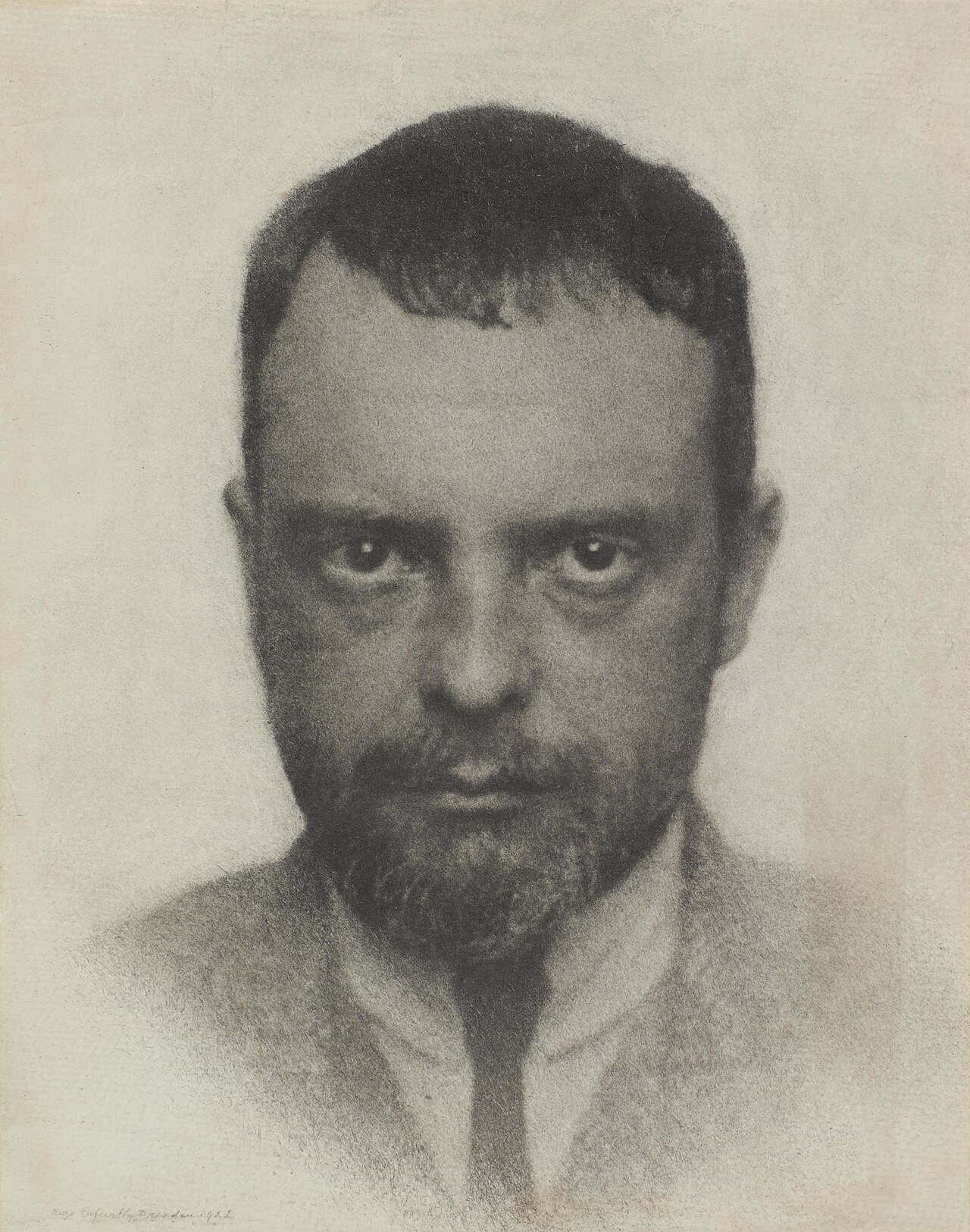
Paul Klee, 1922, © Hugo Erfurth (1922)
Watch: Paul Klee und das Bauhaus (in German)