Per Kirkeby
Per Kirkeby (born 1938 in Kopenhagen; died May 2018 in Kopenhagen.)
Per Kirkeby’s work occupies a distinctive position within postwar European art, situated between abstraction and landscape, materiality and memory, painting and architecture. Trained as a geologist before turning fully toward art, Kirkeby developed a visual language in which the natural world is never simply represented but continuously reconstructed. Across painting, sculpture, drawing, printmaking, film, and writing, he approached the image as a site of accumulation, an unstable terrain in which geological, historical, and psychological layers coexist.
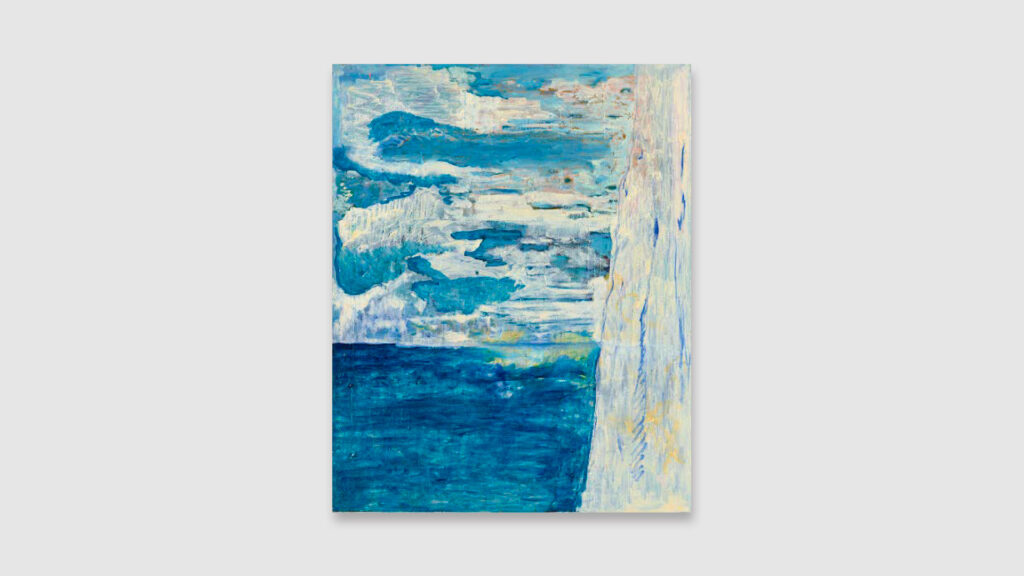
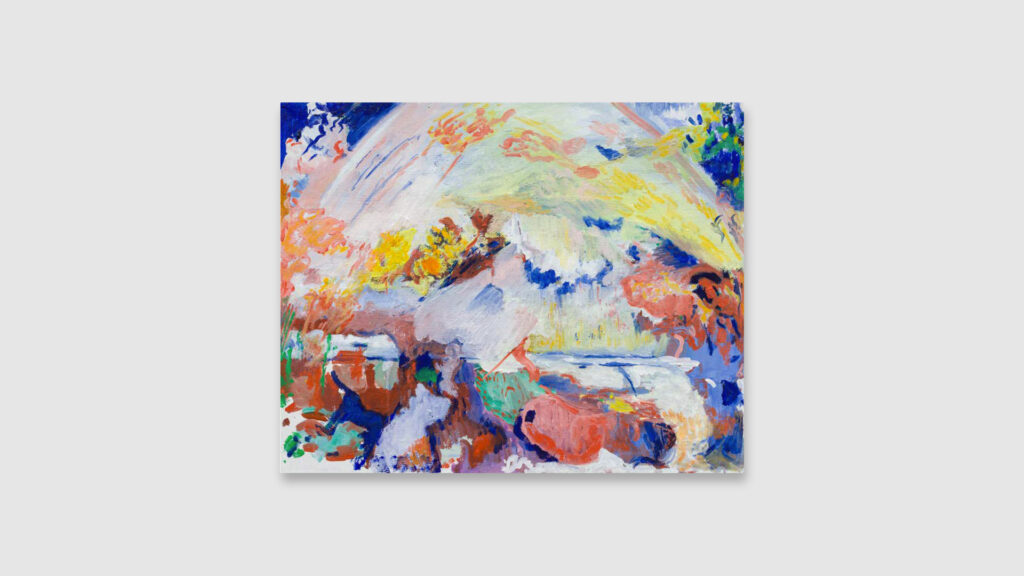
In Kirkeby’s paintings, landscape often appears less as a recognizable place than as a condition of seeing. Dense passages of color, abrupt shifts in scale, and partially submerged forms suggest forests, cliffs, bodies, architecture, or fragments of remembered images without allowing any single reading to become fixed. Figurative elements emerge only to dissolve again into broad fields of paint. The surface becomes something closer to a geological section: built through deposits, fractures, erasures, and repeated transformations.
This understanding of painting as a process rather than an illustration was central to Kirkeby’s practice. His canvases resist the idea of a finished, stable composition. Instead, they reveal traces of revision and contradiction, allowing earlier decisions to remain visible beneath subsequent layers. Color functions not simply descriptively but structurally. Deep greens, earthen reds, luminous yellows, blacks, and mineral blues generate spaces that appear simultaneously organic and constructed, intimate and monumental.
Kirkeby’s background in geology profoundly shaped this conception of form. During scientific expeditions to Greenland in the 1950s and 1960s, he studied landscapes shaped across immense spans of time. Yet geology entered his art not as scientific subject matter but as a way of thinking: an awareness that every visible surface contains histories beneath it. His paintings similarly suggest that an image can never be understood in isolation from what preceded it. They operate through sedimentation, compression, rupture, and erosion.
This concern with structure also extends to Kirkeby’s sculptures and architectural works. His characteristic brick constructions, begun in the 1970s, employ one of architecture’s most basic materials to create forms that exist somewhere between building and sculpture. Walls, passages, arches, and enclosures evoke structures without assuming a conventional function. Like the paintings, they engage the viewer physically, asking how bodies move through space and how material can carry cultural and historical associations.
Although Kirkeby was frequently associated with Neo-Expressionism during the 1980s, his practice ultimately resists such classifications. His work draws equally upon European Romanticism, modernist abstraction, natural history, architecture, cinema, literature, and the history of painting itself. References to artists including Cézanne, Delacroix, Turner, and the traditions of Northern European landscape painting appear not as quotations but as elements absorbed into an evolving visual vocabulary.
At the heart of Kirkeby’s work lies a productive uncertainty between recognition and abstraction. A tree may become a brushstroke; a mountain may become a mass of color; an architectural fragment may dissolve into an atmospheric field. His images continually move between what can be named and what can only be sensed. Rather than offering a landscape to contemplate from a distance, Kirkeby places the viewer inside a field of transformation.
Across more than five decades, Per Kirkeby developed an art concerned with the fundamental instability of images and matter. His works suggest that painting, like the earth itself, is never static: it is shaped by pressure, time, destruction, and renewal. What emerges is not a representation of nature but an equivalent to its processes, a visual archaeology in which memory, history, and material remain perpetually in motion.

© Per Kirkeby Archive, Museum Jorn. Per Kirkeby in Di Bezzo 2012.