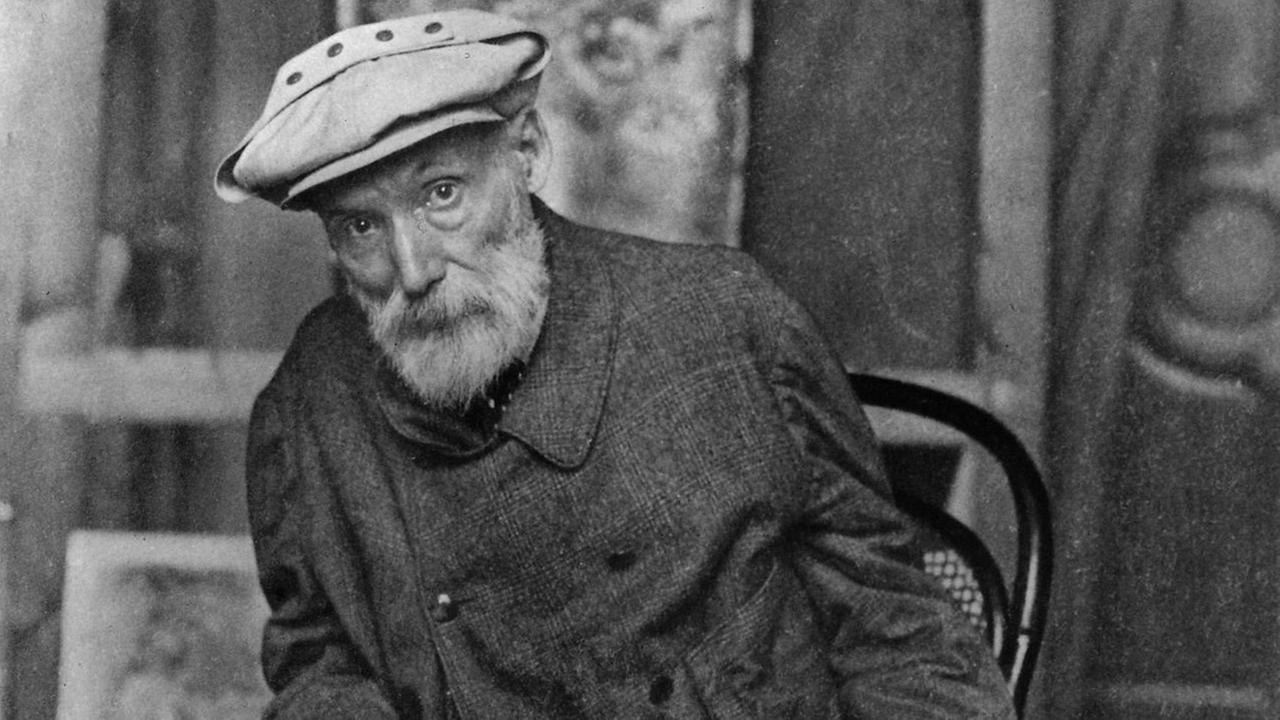
Pierre-Auguste Renoir
Born 1881 in Limoges, Limousin, France; died 1919 in Cagnes-sur-Mer, Côte d’Azur, France
Pierre-Auguste Renoir transformed the pleasures of modern life into a sustained investigation of color, touch, atmosphere, and human presence. Born in Limoges in 1841 and raised in Paris, Renoir emerged as one of the central figures of Impressionism, yet his career consistently exceeded the boundaries of the movement with which he is most closely associated. From scenes of cafés, gardens, theaters, and riverside leisure to portraits, landscapes, bathers, and late mythic figures, his work traces a lifelong effort to reconcile immediacy with structure, perception with memory, and the fleeting conditions of modern experience with the enduring traditions of painting.
Renoir’s earliest training was rooted in craftsmanship. As a young man, he worked as a porcelain painter, decorating plates with floral motifs and ornamental designs before entering formal artistic study. This early sensitivity to surface, color, and decorative rhythm would remain fundamental throughout his career. Even in his most naturalistic paintings, color does not simply describe form; it animates it. Flesh, fabric, water, foliage, and reflected light seem to dissolve into one another, held together less by contour than by a continuously vibrating field of paint.
In the 1860s, Renoir studied in the Paris studio of Charles Gleyre, where he met Claude Monet, Alfred Sisley, and Frédéric Bazille. Together, these artists began working outdoors and exploring a new pictorial language capable of recording the instability of light and atmosphere. Their experiments challenged the conventions of academic painting, which privileged historical, mythological, and religious subjects as well as carefully modeled forms and polished surfaces. Renoir increasingly turned instead toward contemporary life.
What distinguished his contribution to Impressionism was an intense focus on the human figure. While Monet often pursued the changing effects of light across landscape, Renoir repeatedly placed bodies at the center of his compositions. He was fascinated by the way light passes across skin, clothing, hair, and movement, and by the complex social spaces created when figures gather together. His paintings of modern leisure do not merely document nineteenth-century Paris; they construct environments in which intimacy, sociability, observation, and spectacle become inseparable.
In works such as La Grenouillère, made in dialogue with Monet, Renoir explored the fractured reflections and rapid brushwork that became central to Impressionist painting. Water, sky, clothing, and foliage are translated into small, shifting touches of color. Yet even here, the human presence remains crucial. The landscape is not empty nature but a social arena, shaped by modern recreation and the changing rhythms of urban life.
This relationship between modernity and pleasure reaches a remarkable complexity in paintings such as Dance at Le Moulin de la Galette. The scene appears spontaneous: figures dance, converse, turn toward one another, or disappear into the crowd. Sunlight filters through trees, fragmenting bodies and clothing into patches of color. Yet the composition is carefully constructed. Renoir orchestrates glances, gestures, diagonals, and intervals to create the sensation of movement without sacrificing pictorial coherence.
The painting’s modernity lies not simply in its subject but in its instability. No single figure dominates the scene. Instead, the viewer’s attention moves continually across the surface, encountering incomplete exchanges and fleeting social encounters. The image functions almost like memory itself: selective, atmospheric, and unresolved.
Renoir’s portraits reveal another dimension of this interest in human presence. Whether depicting friends, patrons, children, actresses, or members of the Parisian bourgeoisie, he avoided rigid characterization in favor of physical immediacy. Sitters often seem absorbed in their own thoughts, caught between formal presentation and casual intimacy. Clothing, upholstery, flowers, and decorative interiors become extensions of the body, merging portraiture with still life and pattern.
This emphasis on visual pleasure has sometimes led Renoir’s work to be described as effortless or purely sensual. Yet beneath its apparent ease lies a complex and highly deliberate practice. Renoir continually revised his approach to composition and form. By the early 1880s, he had become dissatisfied with what he perceived as the limitations of Impressionism, particularly its tendency toward optical dissolution.
A journey to Italy in 1881 proved decisive. Encountering the works of Raphael and other Renaissance masters, Renoir became increasingly concerned with line, volume, and compositional stability. He began to move away from the more fragmented brushwork of his earlier paintings, seeking a firmer structure for the human figure.
This shift is visible in the works of the 1880s, where contours become more pronounced and bodies more sculptural. Renoir’s art during this period reveals a tension between two impulses: the desire to preserve the luminous color and immediacy of Impressionism and the desire to restore the sense of monumentality he admired in earlier European painting.
Rather than representing a rejection of Impressionism, this development expanded its possibilities. Renoir began to imagine how modern painting could absorb historical traditions without retreating into academic convention. He looked backward in order to move forward.
The female nude became increasingly central to this project. Renoir’s bathers are neither simply contemporary women nor straightforward classical figures. They occupy an ambiguous realm between observation and idealization. Bodies are rendered as rounded, rhythmic forms, often integrated into landscapes in which trees, water, rocks, and flesh share the same visual language.
In these works, Renoir increasingly challenged the distinction between figure and environment. A shoulder may echo the curve of a hillside; warm flesh tones may repeat in the surrounding vegetation; the contours of bodies seem to continue into the landscape. Rather than standing apart from nature, the human figure becomes part of a larger organic continuity.
This tendency grew stronger in his late work. Despite suffering from severe arthritis, Renoir continued to paint with extraordinary intensity. His late canvases are characterized by saturated reds, oranges, greens, and blues, as well as increasingly fluid contours. Figures appear expansive and monumental, their bodies often occupying large portions of the pictorial field.
These late paintings were sometimes criticized by contemporaries for their abundance and sensuality, yet they would prove deeply influential for younger artists. Pablo Picasso, Henri Matisse, and others recognized in Renoir’s late work an alternative path toward modernity, one based not on fragmentation or austerity, but on bodily presence, chromatic intensity, and the reinvention of classical form.
Renoir’s engagement with sculpture in his final years further extended this concern with volume and physicality. Working with collaborators, he translated some of his recurring motifs into three dimensions. These sculptures reveal how profoundly his late painting had already become sculptural: bodies are conceived as masses, curves, and rhythms rather than as anatomically precise descriptions.
Throughout his career, Renoir maintained an extraordinary commitment to the idea of painting as a physical and sensory experience. His surfaces are built from countless small decisions about pressure, transparency, layering, and color. Brushwork moves between description and dissolution. At close range, a face may break apart into touches of pink, blue, yellow, and white; from a distance, these fragments cohere into the sensation of living flesh.
This oscillation between material and image is central to Renoir’s achievement. His paintings continually remind the viewer that representation is constructed from pigment, yet they also insist on painting’s capacity to produce a vivid sense of presence. A figure can appear almost tangible while remaining visibly made of paint.
Renoir’s art is also deeply concerned with proximity. His figures often occupy the foreground, drawing the viewer directly into the pictorial space. Tables, chairs, balconies, gardens, and crowds become devices for negotiating distance. We are rarely positioned as detached observers; instead, we seem to enter a social world already underway.
At the same time, Renoir’s images are often marked by an underlying sense of transience. Conversations will end, crowds will disperse, sunlight will shift, children will grow older, bodies will age. His paintings transform these temporary states into enduring pictorial forms. In this sense, pleasure in Renoir is never entirely separate from time.
This awareness gives his work a greater psychological complexity than its reputation for beauty alone might suggest. The smiles, gestures, and luminous surfaces of his paintings exist within a world defined by change. The apparent ease of modern leisure is itself fleeting, and Renoir’s art repeatedly attempts to hold onto what cannot remain.
His relationship to Impressionism is therefore best understood as both foundational and restless. Renoir helped define the movement’s radical approach to light, color, and contemporary subject matter, but he refused to remain within a fixed stylistic vocabulary. His career moved through successive periods of experimentation, reconsideration, and synthesis.
What remained constant was his belief in the expressive power of painting. Renoir did not seek to reduce the world to a system or theory. Instead, he returned repeatedly to the visible, to faces, bodies, flowers, landscapes, fabrics, water, and light, and asked how paint might make them newly perceptible.
His work occupies a crucial position in the transition from nineteenth-century naturalism to twentieth-century modernism. Renoir demonstrated that radical innovation could emerge through pleasure as much as through disruption. Color could become structural. Sensation could carry intellectual weight. The body could function simultaneously as subject, form, and vehicle for pictorial experimentation.
Today, Pierre-Auguste Renoir is recognized not simply as a painter of beauty or bourgeois leisure, but as an artist who continuously reinvented the relationship between seeing and painting. His work moves between observation and invention, modern life and historical memory, optical sensation and monumental form.
At its most powerful, Renoir’s art transforms the ordinary act of looking into an experience of heightened awareness. Light moves across a dress, a face emerges from a field of color, a group gathers beneath trees, a body becomes inseparable from landscape. These moments remain compelling because they do not merely describe pleasure; they explore how fragile, physical, and temporary pleasure can be.
Across more than six decades of work, Renoir pursued an art in which modernity could remain connected to tradition and in which painting could continue to affirm the sensual presence of the world. His legacy lies precisely in this refusal to choose between immediacy and permanence. Through color, touch, and the human figure, he created images that transform fleeting experience into enduring form.