Raffaello Sanzio da Urbino
Raffaello Sanzio da Urbino (1483–1520), known as Raphael, occupies a defining position in the history of Western art. Working at the height of the Italian Renaissance, he developed a visual language in which clarity, proportion, and psychological observation converge with an extraordinary command of pictorial space.
Born in Urbino and active in Florence before moving to Rome in 1508, Raphael emerged within a culture shaped by humanism, classical antiquity, architecture, and the expanding intellectual ambitions of the Renaissance. While his early work reflects the influence of Pietro Perugino, his encounter with the innovations of Leonardo da Vinci and Michelangelo contributed to a rapid transformation of his practice. Rather than simply adopting their formal discoveries, Raphael absorbed and reorganized them into a language distinguished by balance, lucidity, and structural coherence.
At the center of Raphael’s work is the relationship between the individual figure and the larger order to which it belongs. Bodies, gestures, architecture, landscape, and intervals of empty space are brought into carefully calibrated relationships. His compositions often appear effortless, yet their apparent naturalness is constructed through complex systems of proportion, perspective, rhythm, and movement.
This tension between immediacy and structure is particularly evident in Raphael’s representations of the Madonna and Child. Returning repeatedly to the subject, he transformed a deeply established religious iconography into an evolving investigation of intimacy, gesture, and human presence. Sacred figures retain their symbolic significance while acquiring an emotional and physical proximity that fundamentally altered the possibilities of devotional painting.
Raphael’s portraits similarly move beyond the recording of likeness. Through subtle shifts in posture, expression, gesture, and gaze, the sitter emerges as both a physical presence and a psychological subject. Restraint becomes a means of intensification: rather than dramatizing character, Raphael allows identity to unfold through the controlled relationship between figure, surface, and space.
His arrival in Rome marked a decisive expansion in scale and ambition. Commissioned by Pope Julius II to decorate rooms in the Vatican Palace, Raphael developed monumental compositions in which philosophy, theology, poetry, law, history, and classical thought were brought into dialogue. In The School of Athens (1509–11), architecture becomes a framework for intellectual exchange. Figures gather, separate, gesture, listen, and move through an imagined classical space in which knowledge itself is given visual and spatial form.
Drawing remained fundamental to Raphael’s practice. His preparatory studies reveal a process of continuous revision in which bodies, gestures, and compositional relationships are repeatedly tested before arriving at the apparent resolution of the finished work. These drawings expose the construction underlying his celebrated sense of harmony: equilibrium is not assumed, but discovered through looking, adjustment, and repetition.
Raphael died in Rome in 1520 at the age of thirty-seven. His remarkably brief career nevertheless established a visual vocabulary that would shape European art for centuries. His compositions became points of reference for artists, architects, academies, and theorists, while his understanding of proportion and pictorial organization became inseparable from subsequent ideas of the classical tradition.
Seen from the present, Raphael’s work extends beyond the historical ideal of Renaissance beauty. It examines how images create relationships, between bodies and space, observation and invention, intimacy and monumentality, the individual and the collective.
Harmony, in Raphael’s work, is not simply an aesthetic condition. It is a structure through which the world becomes visible.
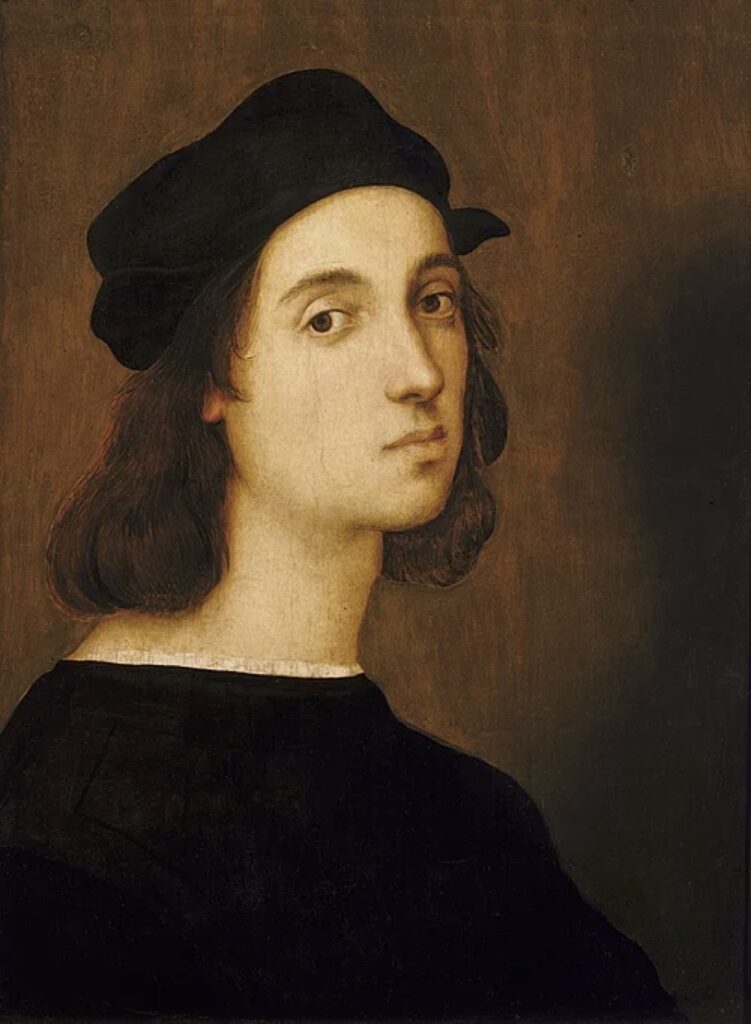
Presumed self-portrait of Raphael, 1504–06