Seol Kwon
Born in Seoul, South Korea, in 1972, Seol Kwon develops a painting practice in which color, gesture, form, and spatial ambiguity converge to create images that remain deliberately open to interpretation. Her paintings unfold through a continuous negotiation between abstraction and representation, between what can be recognized and what remains unresolved. Rather than presenting the viewer with a stable image, Kwon constructs pictorial fields in which forms emerge, disappear, overlap, and reappear, allowing perception itself to become one of the central subjects of the work.
Color occupies a fundamental position within this process. It does not function simply as an expressive or decorative element, nor does it merely describe objects or establish atmosphere. In Kwon’s paintings, color becomes structural. Saturated reds, blues, greens, yellows, oranges, pinks, and violets encounter quieter tonal passages, creating shifting relationships of density, distance, rhythm, and visual weight. Certain colors advance toward the viewer while others seem to withdraw into the pictorial field. At times, adjacent areas intensify one another; elsewhere, contrasting hues interrupt the continuity of the image and redirect the movement of the eye. The resulting compositions rarely offer a single point of entry. Instead, they encourage the gaze to move across the surface, discovering connections between apparently independent forms. A gesture encountered at one edge of the painting may find an unexpected counterpart elsewhere, while a field of color that initially appears autonomous may gradually reveal itself as part of a larger spatial structure. What seems peripheral can become central, just as an element that first dominates the composition may recede as other relationships become visible.
This instability is essential to Kwon’s pictorial language. Within her paintings, fragments of recognizable imagery can appear without becoming fully descriptive. A contour may evoke a body, a landscape, a plant, an object, or an architectural structure, yet these suggestions are rarely allowed to settle into unequivocal representation. They remain suspended within the larger field of painting, moving between recognition and abstraction. The act of seeing therefore becomes active rather than passive. The viewer is continually asked to reconsider what appears to be present: a shape may seem immediately familiar and then lose its identity, while another may initially register as an abstract configuration before gradually suggesting an object or figure. Kwon does not resolve these ambiguities. Instead, she preserves the interval in which perception remains uncertain, and it is precisely within this interval that much of the psychological intensity of the paintings resides.
Kwon’s works suggest that an image is never encountered all at once. Seeing unfolds over time and is shaped by memory, association, expectation, proximity, and duration. What the viewer recognizes in a painting is therefore inseparable from what the viewer brings to it. Rather than treating vision as a neutral mechanism, Kwon’s paintings make visible its instability: the constant movement between what is physically present on the canvas and what the mind attempts to construct from it. This relationship between material presence and mental projection gives the paintings their distinctive openness. They can appear immediate and elusive at the same time. Their surfaces possess the direct physicality of paint, yet the spaces they generate resist being fully located or described.
Layering plays an important role in establishing this condition. Marks and forms appear to accumulate through successive stages of making. Earlier decisions are not always concealed by later ones; traces remain visible beneath or alongside subsequent interventions. Certain areas suggest revision, interruption, erasure, or displacement, while others retain the immediacy of a gesture that appears to have been left untouched. The surface consequently operates as a record of time. This temporality is not narrative in a conventional sense: the paintings do not necessarily describe a sequence of events. Rather, time is registered through the coexistence of different painterly decisions. A mark made at one moment remains visible beside another made later; layers occupy the same surface without entirely cancelling one another. Painting becomes an accumulation of actions, hesitations, corrections, discoveries, and departures, and Kwon’s compositions can thus be understood as structures built through duration.
Yet despite the apparent spontaneity of many gestures, the paintings are not simply records of improvisation. Their openness is counterbalanced by a strong awareness of composition. Areas of chromatic intensity are positioned against passages of relative quiet; dense concentrations of form encounter more expansive spaces; curvilinear movements may be interrupted by harder edges, while small incidents of color can alter the equilibrium of an entire canvas. This tension between intuition and structure is central to Kwon’s practice. Her paintings frequently appear to exist at the threshold between order and instability, establishing a visual logic without allowing that logic to become predictable. Forms relate to one another, but these relationships remain mobile; the composition appears coherent without becoming closed.
Foreground and background are similarly unstable categories. Rather than constructing space according to a conventional perspectival system, Kwon allows spatial relationships to emerge through color, overlap, scale, density, and gesture. A form can simultaneously appear to sit on the surface and to open onto a deeper space. Flat areas of color may suddenly acquire spatial depth, while passages that initially seem atmospheric can return the viewer abruptly to the physical plane of the canvas. The painting continually oscillates between being an image and being an object. This oscillation reinforces the material presence of Kwon’s work: however suggestive her forms may become, they remain fundamentally rooted in paint, in its opacity and transparency, its capacity to cover and reveal, and its ability to produce both surface and illusion. The viewer is never permitted to forget entirely that the apparent spaces of the painting have been constructed through material decisions.
Gesture functions within this structure not simply as evidence of the artist’s hand, but as a means of organizing attention. Some marks possess a rapid, almost calligraphic immediacy; others appear slower, more deliberate, or embedded within broader fields of color. Their differences establish rhythms across the surface, creating moments of acceleration and pause. The eye follows these rhythms, moving between concentrated incidents and open intervals, recognizable fragments and indeterminate forms, chromatic intensity and quieter transitions. Looking becomes temporal: not the instantaneous consumption of an image, but a process of return, revision, and discovery.
The emotional register of Kwon’s paintings is equally difficult to stabilize. Their chromatic intensity can initially suggest exuberance, pleasure, or immediacy, yet closer attention reveals more complicated relationships. Brightness may coexist with interruption, playfulness with tension, and expansive gestures with passages of containment. The paintings therefore resist the tendency to equate strong color with a singular emotional state. Color operates less as an illustration of feeling than as a field in which different sensations can coexist. Kwon’s work does not ask painting to communicate one message or describe one condition. Instead, it allows contradiction to remain present. Spontaneity and control, clarity and uncertainty, surface and depth, familiarity and estrangement are not problems to be resolved but conditions through which the paintings generate meaning.
In this respect, ambiguity is not an absence of meaning but a method. By refusing to determine exactly what a form must represent, Kwon leaves space for perception to remain active. The viewer is not positioned as the recipient of a completed statement but as a participant in the construction of the image. Looking becomes a form of interpretation, and interpretation remains provisional. A painting can therefore change without physically changing: what appeared abstract may become figurative after prolonged observation; a seemingly dominant form may lose its authority as another relationship becomes apparent; a color initially experienced independently may begin to function as part of a larger rhythm extending across the canvas. Such transformations occur within the viewer’s perception rather than on the material surface itself.
Kwon’s paintings make this discrepancy productive. They draw attention to the distance between an object and our experience of that object, between what is present and what we believe ourselves to see. In doing so, they approach painting not simply as a means of producing images but as a way of examining the conditions under which images become meaningful. Memory enters this process indirectly. The paintings do not necessarily depict specific memories, yet their forms can possess the uncertain familiarity of something partially recalled. Recognition arrives without complete identification; an image seems almost known but cannot be fully named. This quality gives the work a particular temporal complexity. The paintings appear simultaneously immediate and retrospective, grounded in the physical present of their surfaces while opening onto associations that may belong elsewhere. A gesture can be encountered both as a material fact and as a trigger for something remembered.
The space of the painting consequently becomes both external and internal. It exists physically before the viewer, yet it also develops through the private associations generated by looking. Kwon does not attempt to control these associations; the openness of the work depends precisely upon their variability. Different viewers may recognize different things, just as the same viewer may experience the painting differently at another moment. Meaning remains contingent rather than fixed. What persists is the structure that makes this multiplicity possible: the relationships between color and form, opacity and transparency, gesture and interval, surface and imagined depth.
Through these relationships, Kwon positions painting as an active perceptual field. Her canvases do not simply contain images; they establish conditions in which images can emerge, disappear, and be reconsidered. They ask what happens when recognition is delayed, when color ceases merely to describe and begins to organize space, when a gesture functions simultaneously as mark and image, and when uncertainty becomes a condition for sustained attention. Their openness derives from their refusal of final resolution, from their capacity to hold different possibilities in suspension and to allow something to be present without being entirely named.
In Kwon’s work, painting becomes less a statement than a continuous proposition. The canvas is not simply the place where an image arrives, but a field in which an image is tested, interrupted, reconstructed, and kept perceptually open. Each painting establishes its own temporary order, yet that order remains susceptible to another glance, another distance, another association. Through color, gesture, layering, and the unstable relationship between abstraction and recognition, Kwon creates paintings whose meaning resides not only in what they show, but in the changing experience of looking itself.
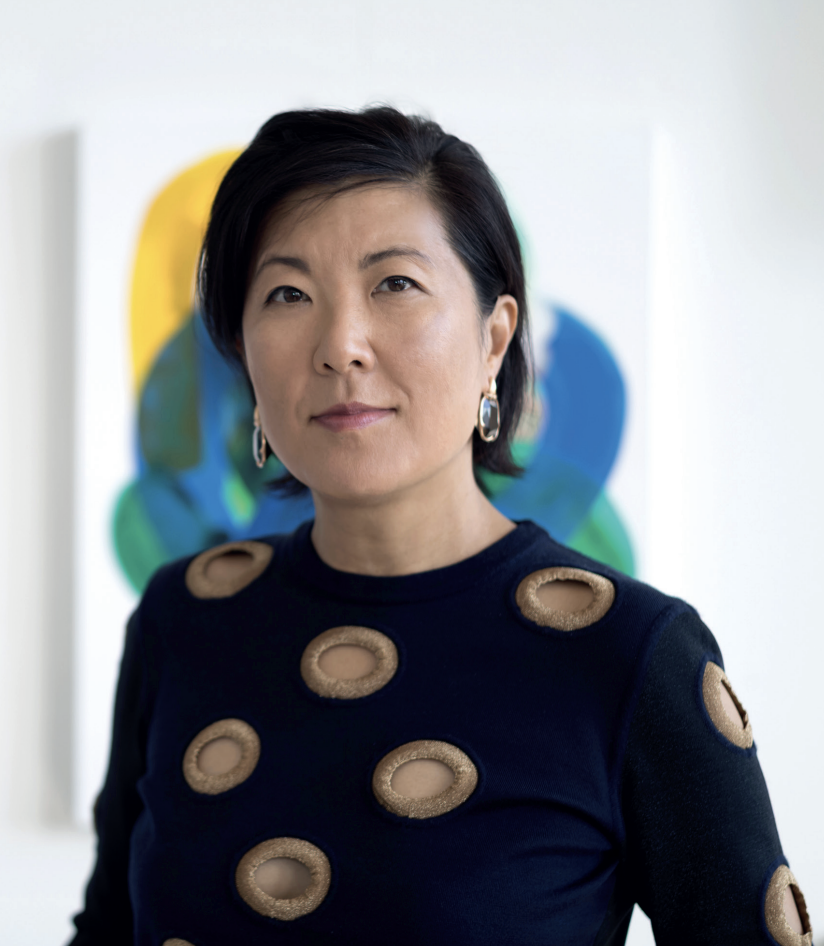
Seol Kwon © The Artist, Photography: Michael Dellefant