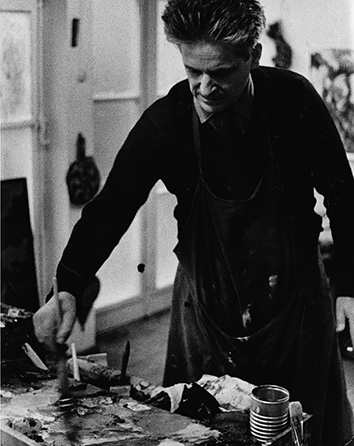
Walter Jonas
Painter, Thinker, Urbanist
Walter Jonas (1910–1979) was a painter, graphic artist, writer, critic, and visionary urban thinker whose practice resisted the conventional boundaries between artistic disciplines. Born in Oberursel, Germany, and raised in Switzerland, he studied painting at the Reimann School in Berlin from 1929 to 1932, where he was a master student of the Expressionist artist Moriz Melzer. After a period in Paris and extensive travels through Europe, Jonas settled permanently in Zurich in 1935.
Drawing and painting remained at the foundation of his work. During the 1940s Jonas developed an extensive graphic practice, including the twenty etchings for Gilgamesch (1943), conceived in the shadow of war and concerned with power, violence, and the recurring ambitions of human civilization. He was closely associated with the writer Friedrich Dürrenmatt, whom he met in 1941, and increasingly occupied a position between visual artist and public intellectual. After the Second World War he returned more intensively to painting; his work was shown internationally, including at the Venice Biennale, while he also became known in Switzerland as an art critic, writer, teacher, and television presenter.
Travel profoundly affected Jonas’s thinking. A stay in India in 1951 exposed him to philosophical and spiritual traditions that reinforced his conviction that artistic practice could address fundamental questions of human existence. His journey to Brazil in 1958 proved even more decisive. Confronted by the rapid expansion, traffic, and immense urban scale of São Paulo and the emergence of Brasília, Jonas began to imagine alternatives to the modern metropolis. According to his own later account, it was in São Paulo that the essential form of his future Intra-House first occurred to him.
First published in 1961 and elaborated in his book Das Intra-Haus. Vision einer Stadt in 1962, Jonas’s Intrapolis proposed a radically different relationship between architecture, infrastructure, nature, and communal life. Enormous funnel-shaped structures, each conceived for approximately 2,000 inhabitants, would rise above the landscape. Terraced apartments and public spaces faced inward toward an open, light-filled center, while transportation and technical infrastructure were separated from pedestrian and residential life. Groups of these structures, connected by bridges, would form a new type of city.
For Jonas, however, Intrapolis was not simply an exercise in futuristic architecture. It was a social proposition. At a moment when postwar European cities were expanding rapidly, he questioned whether density inevitably had to result in congestion, isolation, noise, and alienation. His inverted buildings attempted to combine metropolitan concentration with sunlight, vegetation, shared space, and a renewed sense of community. Architecture became a means of asking how modern human beings might live together.
Around 1964, this utopian project occupied the center of Jonas’s work. He sought to realize an Intra-House prototype for the Swiss National Exhibition, Expo 64 in Lausanne. Although reduced budgets eventually prevented its construction, the project placed Jonas within the emerging international discourse on experimental and megastructural architecture. In 1965 he joined the Groupe international de l’architecture prospective (GIAP) alongside figures including Michel Ragon and Yona Friedman, connecting his work to a broader generation seeking radically new models for the cities of the future.
Yet Jonas never ceased to understand himself fundamentally as an artist. The drawings, models, paintings, texts, and architectural visions belong to the same intellectual project: an attempt to imagine forms capable of reorganizing human experience. Even his earlier involvement with architecture, the murals he created for the Farbhof housing development in Zurich in the 1950s, already brought painting into direct dialogue with the spaces of everyday life.
Painter, thinker, and urbanist, Walter Jonas occupied an unusual position in postwar Swiss culture. He did not merely depict the world around him; he sought to redesign it. In the Zurich of the 1960s, the studio became for Jonas a laboratory in which painting could expand into philosophy, architecture, and ultimately the imagination of another way of living.